
Understanding Reverberation Time (RT60) in Room Acoustics

Reverberation time—also known as RT60—is the measure of how long it takes sound to decay in a room after the source stops. In simple terms, it’s how long an echo “hangs around.” When reverberation time is too high, sound bounces around a space, creating echo, muddled speech, and an uncomfortable environment. When it’s properly controlled through acoustic panels and sound absorption treatments, speech becomes clearer and spaces feel more comfortable.
At DDS Acoustical Specialties, we help clients across schools, offices, gyms, restaurants, and public spaces reduce echo and improve overall room acoustics using data-driven acoustic design.
What Is Reverberation?
When a sound is made, it sends out waves of energy that travel through a room. These waves bounce off hard surfaces like floors, walls, and ceilings until the energy fades. Reverberation happens when those bouncing sound waves reflect back to your ears, creating a blurred or echo-like version of the original sound.
The Bouncy Ball Reverberation Analogy
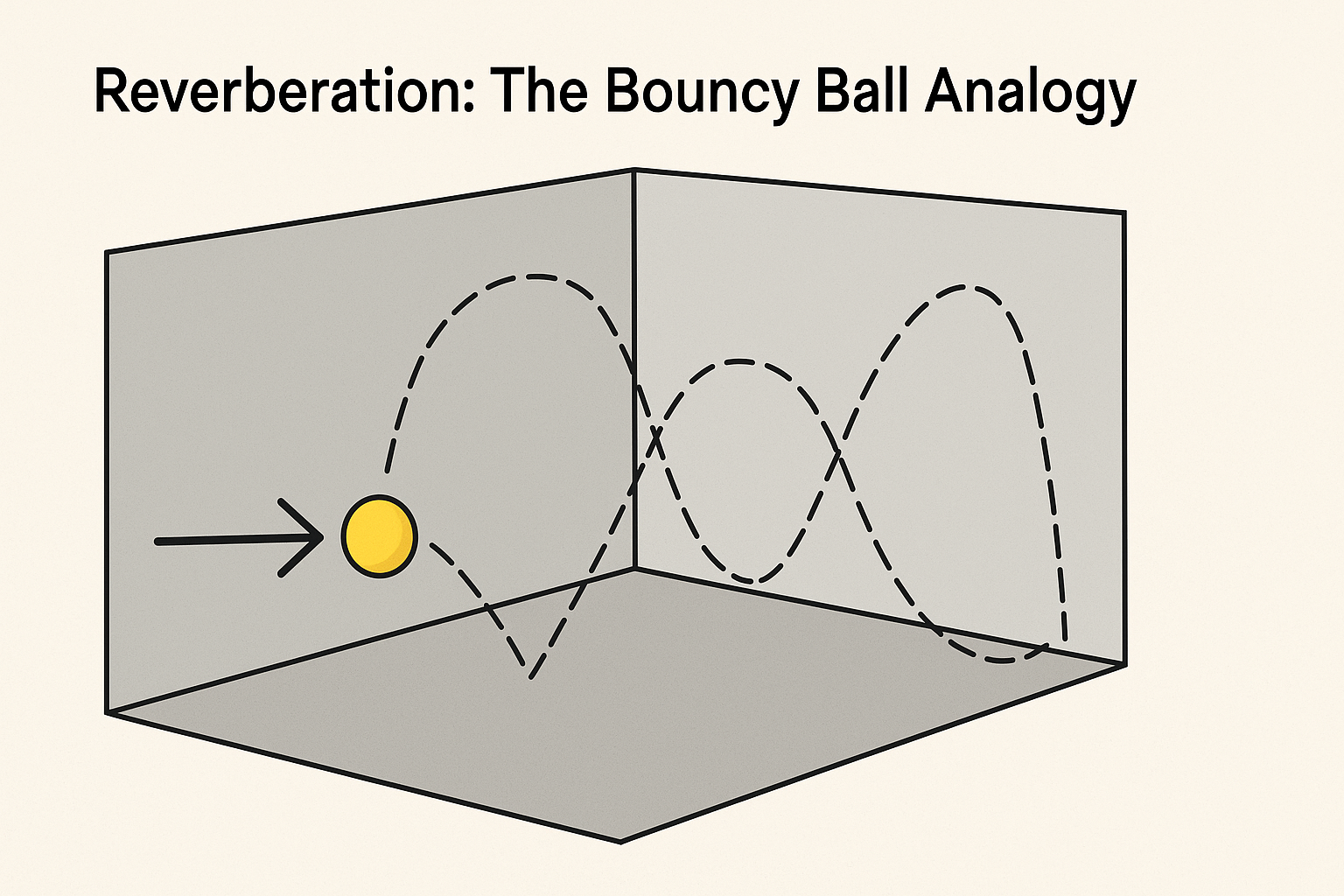
Think of sound like a bouncy ball. When you throw a bouncy ball in a hard, empty room, it keeps bouncing around for a long time. That’s similar to how sound reflects off hard walls, floors, and ceilings — it “reverberates.”
Now imagine placing something soft on the walls and throwing the same ball again. It stops much faster because the soft surface absorbs some of its energy. Sound-absorbing materials work the same way: they reduce how much sound bounces back into the room.
To figure out how much material a space needs, professionals calculate the room’s Reverberation Time (RT60). Shortening that time means adding enough sound-absorbing material to make the room “softer.” The more evenly these materials are installed on the walls or ceiling, the better they work.
What Is Reverberation Time (RT60)?
Reverberation time, or RT60, is the amount of time it takes for sound to decay by 60 decibels after the source stops. Think of it like throwing a ball against a wall. Each bounce represents sound reflecting off a surface—over time, those bounces become softer and slower until they stop completely. That’s how sound behaves in a room.
A high reverberation time means sound energy lingers longer. This can cause echo, poor speech intelligibility, and listening fatigue. On the other hand, a room with too little reverberation feels unnatural or “dead.” The key is achieving the right balance based on how the space is used.
How Reverberation Impacts Real Spaces
Almost everyone has experienced the effects of excessive reverberation firsthand—like trying to have a conversation at a busy restaurant where every voice, plate, and clink of glass bounces around the room. Hard surfaces such as concrete, glass, and drywall reflect sound, causing energy to build up and overlap until voices blend into background noise.
The same problem shows up in countless commercial environments—offices, schools, churches, fitness centers, and public libraries. In each case, the result is the same: frustration, discomfort, and reduced functionality.
The Science Behind the Solution
While many assume you can simply “throw some panels on the wall,” the science says otherwise. The RT60 calculation is a mathematical model and formula that uses a room’s volume and the NRC (Noise Reduction Coefficient) values of materials inside it to determine how much absorption is needed to achieve a target reverberation time.
In other words, it’s not guesswork—it’s data-driven design. By calculating how many Sabins (a unit of sound absorption) are needed, we can determine exactly how much treatment a space requires and where to place it for optimal results.
Placement is equally important. The same number of panels installed haphazardly won’t perform as well as panels placed at key reflection points, such as opposite sound sources or on parallel walls.
What's the ideal reverberation time for a space?
An RT60 less than 1 second is ideal for classrooms, recording studios, test cells, and place where you want sound to be highly controlled and more "dead" sounding.
An RT60 around 1 second is ideal for various applications such as offices, libraries, and most commercial spaces. Speech intelligibility is clear, however, music doesn't sound full, rich, or warm at this level.
An RT60 between 1.5 to 2.5 seconds is a good compromise when a room wants both good speech intelligibility and richer sounding music. This is great for church sanctuaries and performance spaces.
An RT60 greater than 3sec is better for music but results in loss of speech intelligibility and overall comfort.
An RT60 greater than 8 seconds is a very long RT60! You will often find this in large, old cathedrals such as those in Europe. It may be well suited for things like organ music and choir chants and unaccompanied voice.
How can you reduce RT60?
Hard, smooth, and reflective surfaces cause sound waves to bounce around causing high reverberation times. Including soft, porous acoustically absorptive materials help to reduce reverberation. The key is making sure you have enough absorption in the space to reduce it to a desirable level. A couple panels here and there on some walls may not do the trick.
Explore acoustic absorbers:
| Fabric Wrapped Panels | Melamine Foam Panels | Acoustic Baffles |
Tools and Testing
At DDS, we primarily rely on RT60 calculations to design effective acoustic solutions. These calculations, based on accurate volume and material data, are highly reliable for most commercial spaces. When needed, our team also performs on-site acoustic measurements to verify results and confirm the success of each installation.
This combination of data and field expertise ensures every DDS project performs exactly as planned.
Why DIY Fixes Often Don’t Work
While DIY acoustic fixes may seem appealing, they rarely deliver professional results. Many online products promise to “reduce echo instantly,” but without a true RT60 calculation or tested NRC data, the results are unpredictable.
We often visit spaces that were “treated” with cheap foam tiles or decorative felt panels—only for the room to still sound harsh. The difference comes down to measured absorption. Using certified acoustic products and calculated coverage ensures that the treatment actually solves the problem.
What Architects and Designers Should Know
Many architects understand room acoustics well, but for those who don’t, it’s easy to prioritize design over performance. Acoustics isn’t always seen as exciting or visible, and it’s often the first item cut during cost engineering. Unfortunately, that leads to spaces that look great but sound terrible.
When acoustic design is considered early, projects deliver better experiences, reduce costly retrofits, and create environments that feel as good as they look.
The Human Impact of Better Sound
When reverberation is properly controlled, people immediately notice the difference. Rooms feel calmer, communication improves, and the overall experience changes for the better.
Customers frequently tell us they’re amazed by how much clearer and more comfortable their spaces sound after installation. It’s not just about echo—it’s about how people feel in the space. Better sound means less fatigue, better focus, and happier occupants.
Real Examples from DDS Projects

The Provincetown Public Library, housed in a former museum, had a major acoustical problem. Noise from the children’s and teen zones reverberated throughout the upper level, disturbing other visitors. After DDS installed fabric-wrapped acoustic panels in strategic areas, the reverberation time dropped dramatically. The result was a comfortable, balanced environment where everyone could enjoy the space equally.
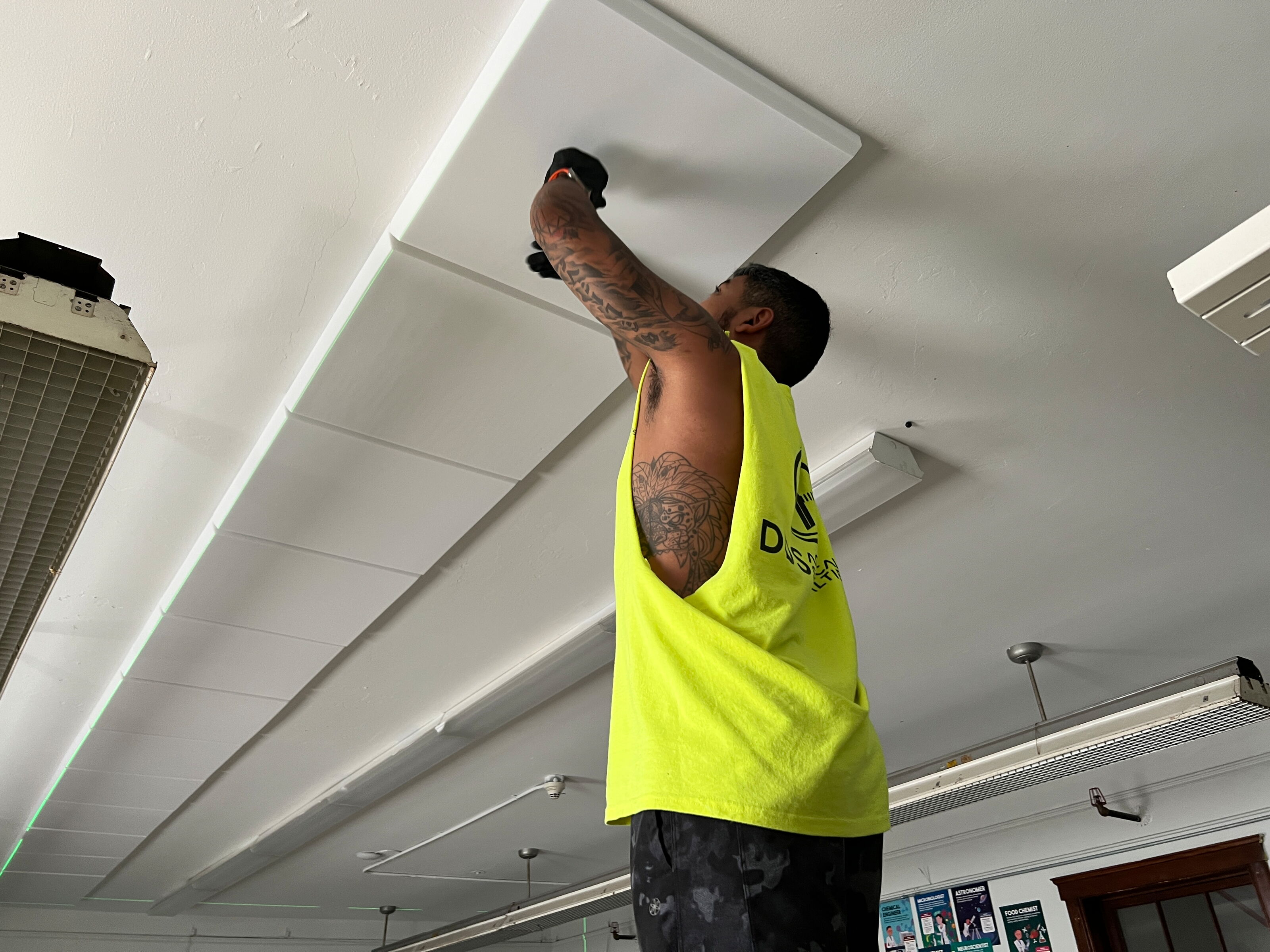
At PVD Prep Charter School, teachers struggled to speak over loud, echoing classrooms and hallways. DDS installed foam ceiling panels to reduce reverberation time across key spaces. After treatment, teachers reported a calmer environment where students could focus—and where communication was effortless.

At Symbotic’s town hall room in Massachusetts, the reverb time started at nearly 4 seconds despite the use of PET panels. DDS added 1,400 square feet of wall panels and 160 ceiling baffles, totaling 4,672 Sabins of sound absorption. After treatment, the space achieved an ideal balance for speech and presentations.
The client’s reaction said it all: “WOW. The space sounds completely different.”
Since the upgrade, the executive team has used the room frequently—with zero acoustic complaints.
The DDS Approach
At DDS Acoustical Specialties, we design each project around science and experience. We calculate reverberation time; model coverage needs and install tested acoustic products to ensure measurable improvement. Our work spans schools, gyms, libraries, offices, churches, and industrial facilities—all with one consistent goal: making spaces sound right.
Calculate Your Space’s Reverberation Time
Curious how your space performs?
Use our free Reverberation Calculator to estimate your RT60, see what your existing reverberation time is and get in touch with a consultant to help you design a budget a solution.