
Childcare Playroom Acoustics: The Goddard School of Framingham, MA

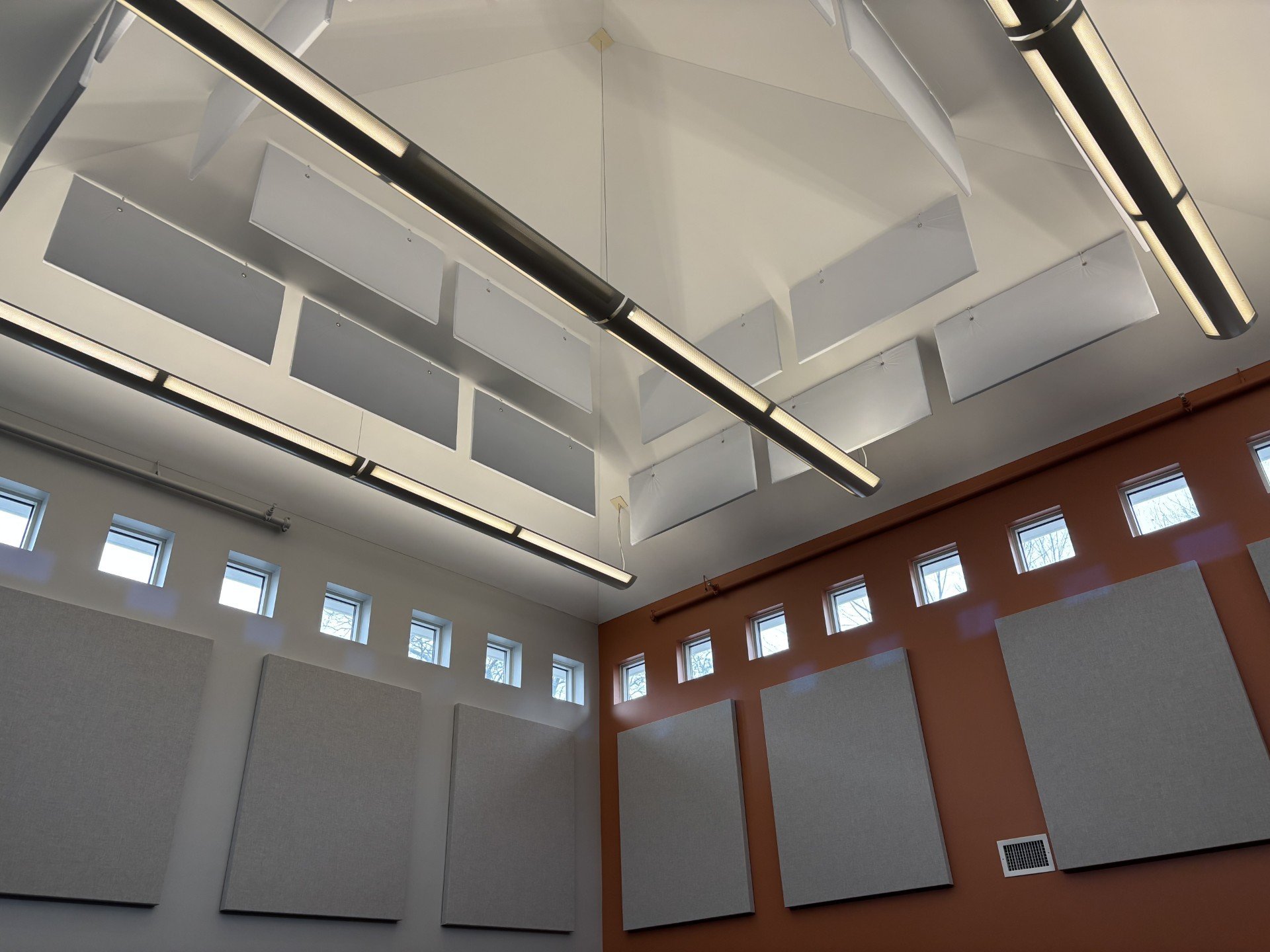
Big room, small ears, a lot less noise
At The Goddard School of Framingham, Massachusetts, the room where children spend the most time was also the one that wore them out the fastest. The largest play and activity space looked bright and welcoming, but it was loud, and the noise made a long day harder for children and teachers alike.
DDS Acoustical Specialties treated the room with a two-layer acoustic system: fabric-wrapped panels around the walls and sealed PVC baffles overhead. Acoustic modeling put the reverberation time near 3 seconds before treatment and roughly 0.67 seconds after, a drop of about 78 percent. The project covered 320 square feet of wall panels and 20 hanging baffles, installed on weekends so the school never lost a day.
The Challenge
The play space climbs to a pyramid-shaped ceiling more than 23 feet overhead, with painted gypsum walls and a thin carpet floor. Those are hard surfaces that throw sound back into the room, and there were more than 9,700 cubic feet of open space for it to travel through.
With almost nothing to absorb the noise, the sound of play kept building on itself. Teachers raised their voices to be heard, the children worked harder to follow directions, and the whole room ran hotter and louder than it needed to. For an early-learning setting, where clear speech is how children learn, that was a real obstacle.
Why echo is harder on little kids
Reverberation time, or RT60, is how long a sound takes to fade away once its source stops, measured as a drop of 60 decibels. The lower the number, the clearer speech sounds. Rooms for young children generally aim for about one second or less. This one modeled near 3 seconds, roughly three times higher than it should be.
At that level, each word lands on top of the echo of the word before it. Young children, who are still building language and still learning to tune out background noise, feel that strain more than adults do. Bringing the reverberation down is one of the most direct ways to cut echo and settle a room.
Catching the sound high and low
DDS Acoustical Specialties measured and modeled the room, then built the treatment in two layers that put absorption where it does the most good.
Around the room, twenty two-inch fabric-wrapped acoustic panels (320 square feet of them) went on the walls. They sit above the doors and below the band of clerestory windows, out of small hands' reach and clear of the glass. Overhead, twenty sealed PVC ceiling baffles hang beneath the sloped ceiling, kept level so each one pulls its full weight against the pyramid geometry.
Treating the walls and the ceiling together is what tames a room with this much height and volume, because sound arrives from every direction, not one.
Two products, two jobs
Fabric-wrapped acoustic panels
The wall panels use a high-density fiberglass core finished in an acoustically transparent fabric. They absorb mid and high frequency reflections, tame reverberation, and are built to order in custom sizes and finishes. The panels are Class A fire rated, available from one half inch to four inches thick, and reach an NRC as high as 1.20 in the deepest builds. The Goddard playroom used two-inch panels.
Sealed PVC acoustic baffles
Overhead, the room uses baffles with a fiberglass core sealed inside a light-reflective white PVC skin. The sealed surface wipes clean in seconds and carries a sanitary rating, which makes it a sensible choice for a room full of toddlers. Suspended from the high ceiling, the baffles reach the height the wall panels cannot.
Installed without losing a school day
Because the center runs from early morning to early evening, the work was scheduled for weekends and off hours. Crews used scaffolding to reach the high, sloped ceiling and set every baffle at the same level so the array would perform as designed. The school never had to close or relocate a class.
What changed when the noise dropped
Acoustic modeling sized the treatment to take the room from about 3 seconds of reverberation down to roughly 0.67 seconds, close to a 78 percent drop and a level that suits a room for young children. Overall sound levels come down about 6 decibels, which the ear reads as roughly a third quieter.
Nothing about the room's look changed. The tall ceiling and the wall of windows are still there. What changed is how it feels to be inside it: voices carry, directions land the first time, and a busy play day is easier on the children and the staff.
Let's quiet your loudest room
DDS Acoustical Specialties designs and installs acoustic treatments that make rooms easier to hear, learn, and work in. From childcare centers and classrooms to gymnasiums, offices, restaurants, and houses of worship, we measure the problem, model the result, and handle the installation.
You can estimate your own space with our room analysis calculator, browse more finished work in the project gallery, or see a similar learning space in our case study on baffles and wall panels at Las Americas ASPIRA